ai
Kanban Operations: A Read-Only Plugin for Hermes Desktop
A case study in giving operators a useful Kanban view without letting an external plugin reach into private APIs, SQLite, or task mutations.
- #ai-agents
- #hermes
- #plugins
- #kanban
- #api-design
Problem
A Kanban board is useful only when an operator can see enough context to decide what to do next: the work queue, task detail, activity, attachments, worker output, and the current state of a run.
The easy way to build that view is also the wrong way. An external desktop plugin could reach for private HTTP routes, read the host application's SQLite database, or quietly gain mutation paths it was never meant to have.
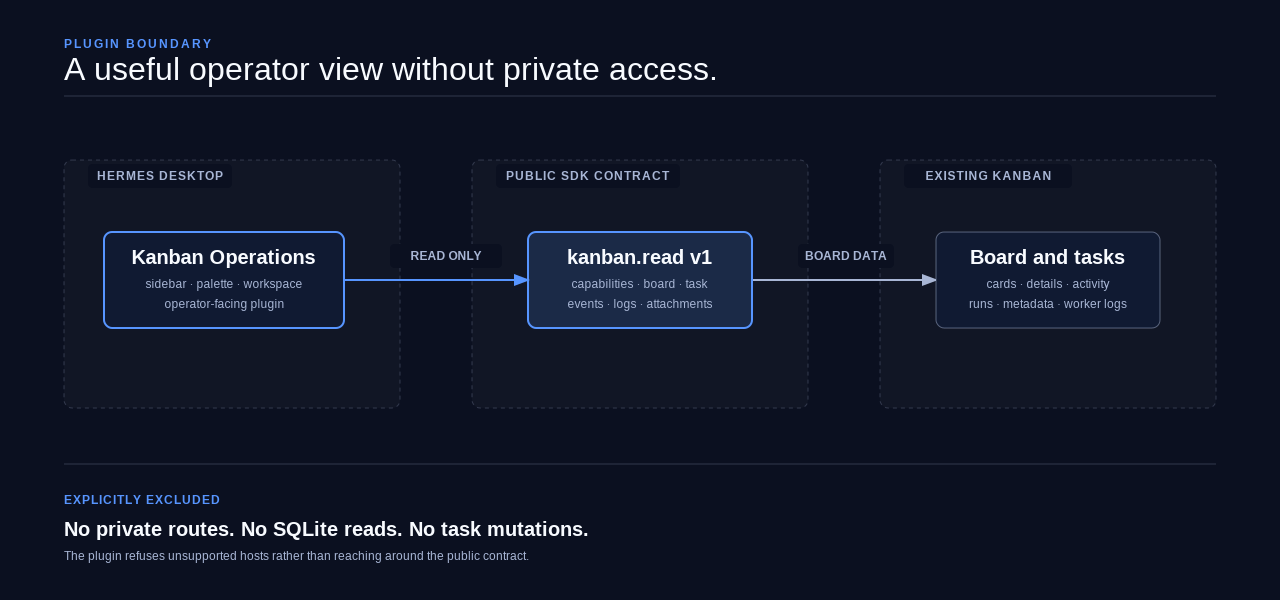
I built Kanban Operations for Hermes Desktop around the opposite idea: give an operator a useful console while making the permission boundary obvious. It is a read-only view over Kanban work—not another control plane.
Constraints
The plugin needed to be useful without relying on accidental access.
- No private integrations. It must not call Hermes' private Kanban routes or read the host database directly.
- No mutations. It cannot create, edit, comment on, move, delete, reassign, upload, approve, or dispatch work.
- Compatibility is explicit. A plugin needs to know whether the host supports the public API it requires, rather than failing later in an ambiguous state.
- The operator remains in context. If a profile or board is not selected, the plugin should respect Hermes' active context instead of guessing a default.
- Trust is still required. Desktop runtime plugins run with renderer authority, so “read-only” is a contract enforced by deliberately narrow API use and reviewable code—not a claim that plugins are sandboxed.
Build
The design has two intentionally separate pieces.
A public read contract
Rather than depending on private implementation details, the plugin targets a narrow kanban.read surface. It checks capabilities first and requires version 1 plus the specific features it needs: board, task, attachment, log, and event reads.
If the host does not support that contract, the console renders a clear unsupported-version state. It does not crash, probe private endpoints, or fall back to SQLite.
A small desktop plugin
The standalone plugin registers a sidebar entry, a command-palette action, and a dedicated workspace route. It renders:
- board columns and task cards;
- read-only task detail, comments, activity, dependencies, runs, and attachment metadata;
- a read-only worker-log tail; and
- event updates with polling fallback when live events are unavailable.
The route lifecycle was a real engineering concern. Enabling a runtime plugin after Desktop startup must still mount a visible workspace page, not merely register an item in the sidebar. The current local release keeps the route registered for the plugin lifetime and opens Hermes' dynamic workspace surface when selected.
This is the same engineering instinct behind my evidence-led Hermes workflow: a useful agent interface needs explicit scope, observable state, and an honest boundary around what it can change.
Result
The current local plugin release is 0.1.4. Its contract test suite verifies four critical claims:
- only supported ESM imports are used;
- the plugin uses the public read-only SDK surface and negotiates compatibility;
- runtime enabling registers and renders the workspace route; and
- the manifest pins
kanban.readpermission and the API compatibility versions.
The plugin tests pass locally. In the isolated Desktop validation recorded for this build, the board and read-only detail view rendered successfully.
There is an important release boundary: the standalone plugin is still local and unpublished, and the accompanying public read-API work remains a separate integration task rather than a claim about current Hermes core distribution.
Lesson
Extensibility is not giving every plugin more access. It is designing a stable, narrow contract that lets a plugin solve a real operator problem without coupling it to private implementation details.
For this project, that meant read capabilities instead of database access, compatibility negotiation instead of assumptions, and a visible unsupported state instead of a silent failure. The result is a more useful operator view and a safer path for future plugin development.
Source notes
This article describes a local, unpublished Hermes Desktop plugin built by me. It does not claim that the plugin is part of Hermes core, publicly distributed, sandboxed, or available in every Hermes installation. Current Hermes platform documentation is available at the official Hermes Agent documentation.
Related posts
Continue with articles that overlap in category or shared tags.
ai
I built Cuqe so a small local model can say no to an agent's action
A 0.6B verifier that runs on a Mac, scores whether a proposed action matches the request, and declines anything under a calibrated cutoff. In archived development runs it kept 39 of 48 correct actions, declined 44 of 48 when the right action was missing, and answered at 365 ms p95.
Read related postai
I built agent-guard to decide whether an agent's change should go live
A check-apply-verify harness for agent edits. It probes the live system first, applies the change, probes again, and rolls back with a fresh recovery probe when the change breaks something. 24 of 24 replayed scenarios land on the exit code they should.
Read related postai
I built cue-bench to score browser agents on messy retail work
A local Playwright workbench, matched replays, and a ledger grader. 172 receiving attempts, zero recovery passes, and one run that posted 13 ink jackets and zero moss jackets.
Read related post