ai
A Safe Hermes Agent Workflow: Evidence, Approval Gates, Verification
An evidence-led Hermes Agent workflow for delegated engineering work: narrow scope, durable context, verification, and explicit approval gates.
- #ai-agents
- #tooling
- #cli
- #verification
- #agent-safety
Problem
AI agents become risky when scope, evidence, authority, and verification blur together. A broad prompt can look productive while quietly mixing research, code changes, browser actions, private context, and decisions that should still belong to a person.
That is not the kind of engineering workflow I want to build around.
I use Hermes Agent as a practical workspace for AI-assisted development and research. The useful question is not “how much can the agent do?” It is: what can it do safely, what proof does it need, and where should it stop?
Constraints
The workflow is intentionally designed around boundaries rather than autonomy theatre.
- Specialists need a narrow job. A technical reviewer, an SEO reviewer, and a job-search researcher should not share one vague “do everything” brief.
- Context is useful but sensitive. Durable preferences and project context should make work more continuous, not become a reason to expose client details, credentials, or private history.
- Research is not proof. A search result, a passing build, and a live business outcome are different kinds of evidence. The workflow must say which one it has.
- Drafting is not acting. An agent can prepare a report, a change set, or an application draft. It should not quietly send, publish, contact, purchase, or mutate a consequential system.
That last rule matters. The right behaviour for an uncertain or high-impact task is often to stop with a clear decision for the human owner.
Build
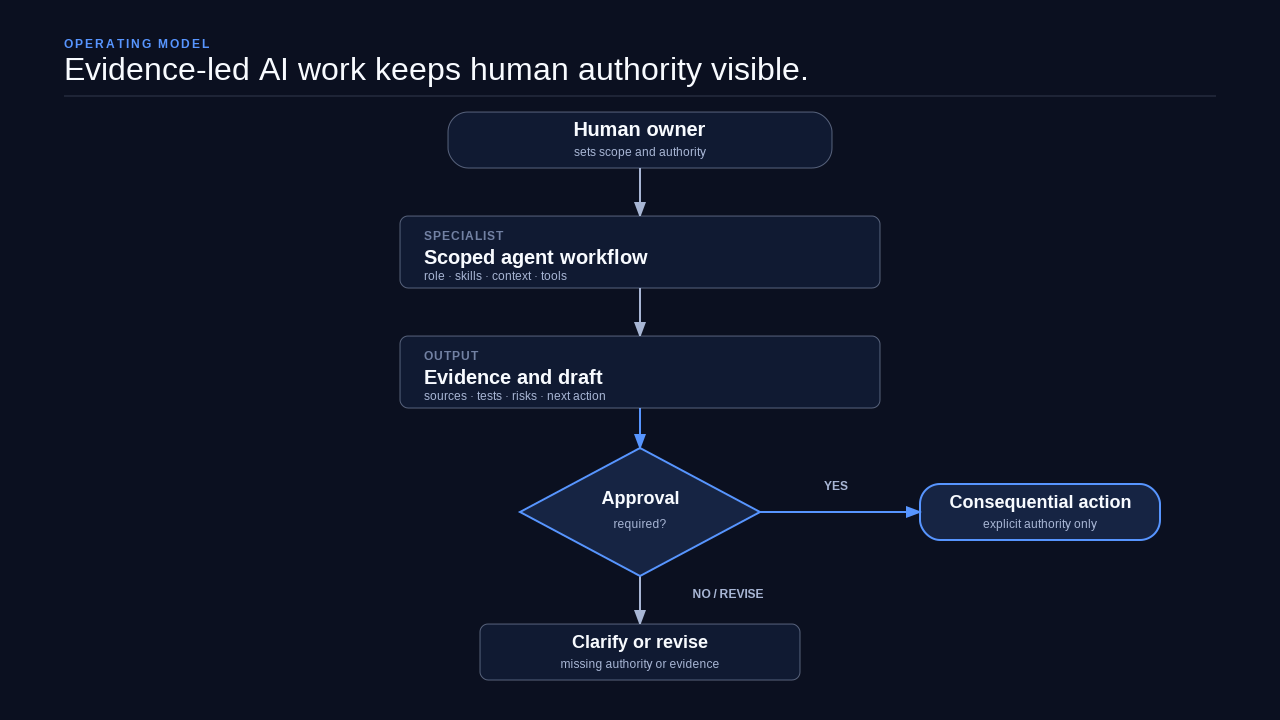
I structure the workflow as a small operating system for delegated work.
1. Start with a role, not a generic chat
The first boundary is responsibility. I create focused profiles and instructions for different jobs, rather than treating one all-access agent as a substitute for every specialist.
For example, a job-search workflow can research and prepare draft-only material, while a technical workflow can inspect a repository, make a scoped implementation, and run its verification suite. The role explains what good output looks like, which facts must be verified, and which actions are out of bounds.
Hermes supports this model through named profiles and specialist bots with their own roles, memories, and skills. The important design choice is mine: the profile is a contract, not a personality prompt. Hermes Bot Mode provides the isolation; the operating rules decide whether the result is dependable.
2. Carry forward the right context
Repeatedly reconstructing a project wastes time and creates opportunities for drift. I use bounded, curated context for stable preferences, project conventions, and known constraints, then retrieve past session context when it is genuinely relevant.
Two mechanisms help keep that practical:
- Persistent memory holds compact, durable facts rather than a raw transcript dump.
- Skills capture reusable procedures that the agent loads only when the task calls for them.
The guardrail is equally important: private project names, customer information, credentials, and unapproved outcomes do not become public portfolio copy just because they are available in a working environment.
3. Make evidence part of the task
A useful agent workflow distinguishes between a plausible answer and a verified result.
For research, that means preferring primary sources and retaining source URLs. For code, it means reading the actual repository, changing only the scoped files, and running the relevant tests or build. For an external change, it means reading back the target instead of trusting a success message.
This is the same instinct behind keeping core behavior testable and workflow state inspectable, and behind explicit, non-secret handoffs that fail closed when context does not match. The AI layer should strengthen that discipline, not replace it with confidence.
4. Put approval gates at consequential boundaries
The workflow stays useful because it does not give every task the same authority.
I treat actions such as sending messages, submitting applications, publishing content, changing production state, or spending money as explicit approval points. Before that point, the agent can prepare the facts, the draft, the diff, the risks, and the exact next action. The human owner decides whether it crosses the boundary.
Hermes has security controls for tool use and command approval, but good governance is more than a platform setting. It is the habit of making authority visible in the task design. The platform's security model is useful because it supports defence in depth rather than assuming a single prompt is enough.
Result
The result is not an “autonomous employee.” It is a repeatable, reviewable way to use AI for real engineering work:
- focused specialists work from a clear brief instead of a sprawling conversation;
- durable context reduces needless re-explanation without turning private material into public claims;
- sources, tests, and read-backs make outputs easier to inspect;
- drafts stay drafts until a human approves the consequential step; and
- the workflow can stop cleanly when evidence or authority is missing.
That is a stronger signal to me than a flashy demo. It shows how I approach systems that touch messy inputs, incomplete information, and real operational risk: give each part a clear owner, make the state observable, and keep the irreversible decision explicit.
The same preference for narrow scope and honest limits shaped a narrowly scoped operator tool with its security limits stated plainly. The implementation changes; the engineering judgment does not.
Lesson
The best AI workflow is not the one that takes the most control. It is the one that makes control, evidence, and responsibility legible.
Using AI well is an integration problem: context has to arrive in the right place, specialist work needs clean interfaces, outputs need validation, and human judgment must remain at the boundary where consequences become real.
That is the systems-and-integration work behind my engineering approach. You can see more of it on my About page.
Source notes
This article describes my workflow built around Hermes Agent; it does not claim ownership of Hermes Agent or make productivity or production-scale claims. Platform capabilities referenced here are linked to the current Hermes Agent documentation.
Related posts
Continue with articles that overlap in category or shared tags.
ai
AI Is Not the System of Record
A practical framework for using AI in workflow-heavy systems without confusing a helpful model with the source of truth.
Read related postengineering
Codex Cross-Session: Moving an AI Coding Session Between Macs
A repo-backed session migration tool that keeps Codex handoffs explicit, non-secret, and fail-closed.
Read related postai
I built Cuqe so a small local model can say no to an agent's action
A 0.6B verifier that runs on a Mac, scores whether a proposed action matches the request, and declines anything under a calibrated cutoff. In archived development runs it kept 39 of 48 correct actions, declined 44 of 48 when the right action was missing, and answered at 365 ms p95.
Read related post