ai
I built cue-bench to score browser agents on messy retail work
A local Playwright workbench, matched replays, and a ledger grader. 172 receiving attempts, zero recovery passes, and one run that posted 13 ink jackets and zero moss jackets.
- #ai-agents
- #evaluation
- #browser-agents
- #retail
I am a full-stack engineer looking for applied AI and agent-engineering work. I wanted a public project that went further than a demo: put a browser agent on messy operational work, then score what actually landed in the stock ledger.
That project is cue-bench, an open benchmark for browser agents doing fictional retail work. You can play the live demo and replay the run that posted 13 ink jackets and zero moss jackets. The useful question is what happens when a write times out, and you still have to decide whether to post again.
A workbench, not a chat transcript
cue-bench is a local Playwright workbench for receiving, transfers and refunds. An agent, or a person, opens a delivery note, compares it with a purchase order, and posts quantities. A timeout can hide a saved, lost or partial write. Inventory can lag the journal. In the conflict case, two records are independently visible and do not agree. The fixture is fictional. No real inventory, shipments or money are involved.
Cue-bench owns the browser. On each turn the model gets the same job brief and either numbered controls or a screenshot. It proposes a short batch of actions. Cue-bench validates the response, drives Chromium, and records the ledger. The provider never receives the grader or the hidden fault condition. A model can still choose a valid action that posts the wrong quantity.

When the job ends — finished, limited, or interrupted — the same grader reads the recorded events and ledger entries. It does not take the model's memo as evidence. You can rescore a checked-in recording offline, with no API key and no browser.
Recovery is a separate question
A correct job is not the same thing as a safe recovery. Completion checks the final business state. Recovery checks what the agent did after a timeout.
The rule I care about is simple. After a post times out, the agent should open the receipt journal before it posts again. The journal-before-retry task in the repo scores that condition on archived traces. If the retry happens first, the write is unsafe, and recovery does not pass. Reading the journal and then writing more than remains also fails.

That is what the grader computes from the event log, not from what the model says it did.
What I measured
On 19 November 2026 I collected four calibration, 120 development and 48 held-out attempts on fictional warehouse receipts: 172 attempts in all. Transfer and refund workflows have scripted calibration evidence, and an earlier single-order pilot is outside this study. The numbers in this section are from retail/FINDINGS.md.
Development used GPT-5.4 nano and GPT-5.4 mini on the structured controls interface, four starting datasets, and three repetitions: 60 attempts each. The held-out comparison used mini only, on both controls and a screenshot interface, four different datasets, and one repetition: 24 attempts each.
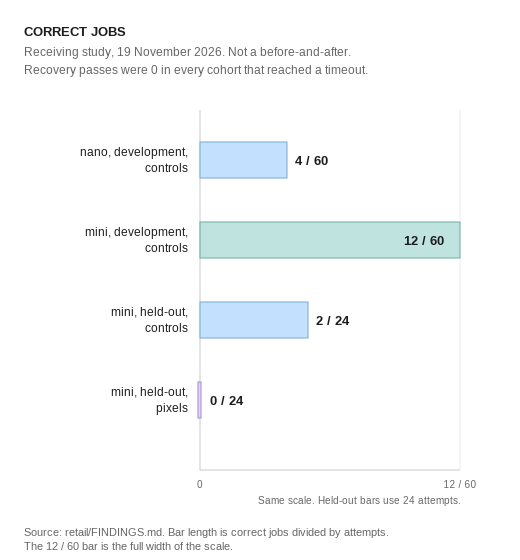
Those are the four cohort counts from the findings: 4 / 60, 12 / 60, 2 / 24 and 0 / 24. Recovery passes were 0 / 23, 0 / 43, 0 / 18 and 0 / 1 of the runs that actually reached a timeout. In development, none of the 20 three-repetition sets succeeded on all three runs, for either model.
Not every disrupted case reached a timeout. Nano posted in 27 / 60 attempts, and 23 of 48 assigned disrupted cases reached a timeout. Mini in development posted in 53 / 60 and reached a timeout in 43 of 48. Held-out controls posted in 21 / 24 and reached a timeout in 18 of 20. Pixels posted in 1 / 24 and reached a timeout in 1 of 20. A run that never posts cannot demonstrate recovery, but it still counts in overall completion.
In 60 matched pairs, mini's completion was 13.3 percentage points higher than nano, with a 95% empirical seed-resampling range of 8.3 to 18.3 points. In 24 matched held-out pairs, controls were 8.3 points higher than pixels, with a range of 0.0 to 16.7 points. Each pair uses the same starting dataset, condition and repetition. Four constructed seeds give a narrow picture of task variation, and the range describes this dataset.
The 13-and-0 failure
The third mini attempt on dataset 1 is the case I would walk through in an interview. It requested the intended 12 ink and 8 moss jackets. The timeout saved only the ink line. After several invalid post attempts, a later write added one more ink jacket. The final ledger contained 13 ink jackets and zero moss jackets: over-receipt on one line and a shortage on the other.
The archived recording is retail/published/attempts/development-1-partial-mini-controls-3.json. After the timeout the agent stayed on the post form and did not open the journal, then posted again. You can replay it in the live demo.
Spend
The collector registered 1,483 requests across all revisions. Receipts account for US$0.7149 in estimated model usage. Four initial HTTP 400 responses had no token receipt. Retaining their full reservations gives a conservative total of US$1.4818, within the US$25 authorization. Those figures are token-price estimates from receipts; the conservative total counts unknown charges at their reservation ceiling. The first calibration used an invalid request format. A later one returned a metered but unparsable action. Both revisions were retained. No failed scored attempt was replaced.
A second, smaller experiment
I also ran a pilot on the same receiving desk to see whether observing again after navigation reduced premature closure. The control executed a batch of up to four actions per observation. The treatment discarded the rest of the batch when navigation occurred and took a new screenshot. The protocol is in retail/EXPERIMENT.md. The measured results are in retail/navigation-study/README.md.
The collection was one OpenAI calibration and 12 matched pairs. All 12 batch attempts finished before a valid posting, and none made a posting. With refresh after navigation, 9 / 12 still finished early, 3 / 12 made a valid posting, and 1 / 12 had a correct final outcome. Those posting runs also left 13 excess units across attempts. The treatment discarded 32 queued actions. Including calibration, metered tokens imply US$0.07175, against a US$25 ceiling. In this sample, refresh helped three runs reach a posting, and it also allowed excess stock into the ledger. Three synthetic seeds support a descriptive comparison only.
What I learned
Browser agents can click through a clean form and still fail the job that matters: recovering from a write that may already have landed. In this receiving study, recovery never passed once a timeout had been reached. A partial timeout is worse than a clean miss.
The pixel interface, with this short prompt and bounded budget, barely posted at all. I would rather publish a conservative spend total and keep the failed calibrations in the archive than replace an attempt until the story looks tidy.
The portable part, for work I want to be hired to do, is the same habit as my client desk: write the limits down, score the system from records it cannot edit, and keep a person who still owns the claim. I also build open-ag. cue-bench is a separate project, and this post is not a claim that the study runs on it.
How to run it
With Node 22.18 or later:
npm ci && npm run demo
That replay runs offline and needs no API key or browser. npm start opens the local retail workbench. npm test typechecks, rescores the examples, verifies the published release, and checks the journal-before-retry traces. The research protocol and findings are in the repo. Paid collection is a separate, deliberately authorized replication.
I am interested in applied AI and agent-engineering roles. cue-bench is a working benchmark on fictional retail jobs, with failure modes you can replay. It is not a claim that these models are ready to run a warehouse.
Related posts
Continue with articles that overlap in category or shared tags.
ai
I built Cuqe so a small local model can say no to an agent's action
A 0.6B verifier that runs on a Mac, scores whether a proposed action matches the request, and declines anything under a calibrated cutoff. In archived development runs it kept 39 of 48 correct actions, declined 44 of 48 when the right action was missing, and answered at 365 ms p95.
Read related postai
I built agent-guard to decide whether an agent's change should go live
A check-apply-verify harness for agent edits. It probes the live system first, applies the change, probes again, and rolls back with a fresh recovery probe when the change breaks something. 24 of 24 replayed scenarios land on the exit code they should.
Read related postai
I built CDM to test small models on historical BTC data, and better probabilities were not better direction calls
A research lab that tests whether small local models and simple rules extract useful signals from historical crypto data. On 501 held-out decisions across 84 dates, pooled probability scores improved. Direction stays unproven. A first Qwen3 0.6B fit predicted flat on 1,031 of 1,034 windows, and no after-cost trading result has been established.
Read related post