ai
I built CDM to test small models on historical BTC data, and better probabilities were not better direction calls
A research lab that tests whether small local models and simple rules extract useful signals from historical crypto data. On 501 held-out decisions across 84 dates, pooled probability scores improved. Direction stays unproven. A first Qwen3 0.6B fit predicted flat on 1,031 of 1,034 windows, and no after-cost trading result has been established.
- #small-models
- #evaluation
- #decision-making
I build AI agents and the checks that decide whether their work counts. My last post was about Cuqe, a small local model that can decline an agent's action. This one is a different kind of check: whether a compact model, or a simple rule, can extract a useful signal from historical crypto data.
That project is CDM, Crypto Decision Maker. It's a research lab, not a trading bot. It starts with BTC, compares models of at most 1 billion parameters with simple baselines, and labels each window up, down or flat. Nothing in it places a live order, and no after-cost trading result has been established. There's a project page with the method and the experiment cards; this post is the evidence.
As of 24 November 2026, fits and strategy scoring are parked. Both December checks remain paused. The rest of this post is about what the ledger already shows, and why the work stopped there.
Three different questions
A model can pass one of these and fail the next. I score them separately.
- Probability quality. Are the up, down and flat probabilities better than past frequencies?
- Direction accuracy. Does it call up or down correctly more often than a simple momentum rule, and more often than staying flat?
- After-cost trading performance. Would its trades win after costs?
Only the first of these has a pass.
The probability study that passed
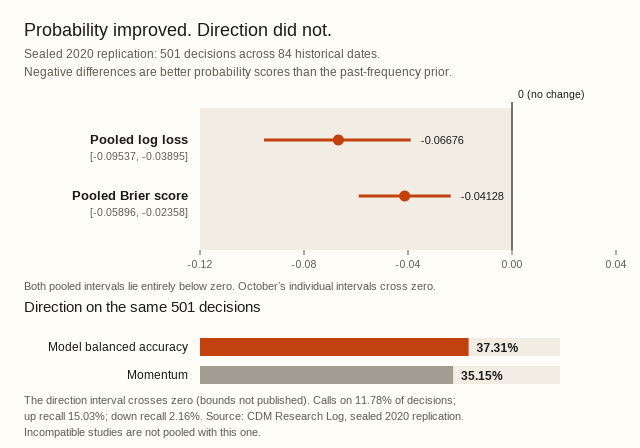
The strongest probability result is a sealed 2020 replication: 501 decisions across 84 historical dates, scored by the unchanged program.
All three periods improved on both probability metrics by point estimate. The pooled log-loss difference was −0.06676, with interval −0.09537 to −0.03895. The pooled Brier difference was −0.04128, with interval −0.05896 to −0.02358. October's individual intervals cross zero. The pooled probability gate passed.
Direction on the same decisions was inconclusive: 37.31% balanced accuracy against momentum at 35.15%, with an interval that crosses zero. It made a directional call on 11.78% of decisions, with up recall of 15.03% and down recall of 2.16%. Better probabilities were not reliable direction calls, and this was not an after-cost trading result.
Scroll sideways to read it. The labels stay full size.
A first Qwen fit mostly predicted flat
I also fitted a Qwen3 0.6B LoRA on verified historical BTC trades. The fit completed 141 optimizer steps in 51 seconds. The pipeline converted 2,977,383 verified BTC trades into 1,128 training examples. All 16 LoRA tensors changed, and a fresh process loaded the saved adapter and matched inference.
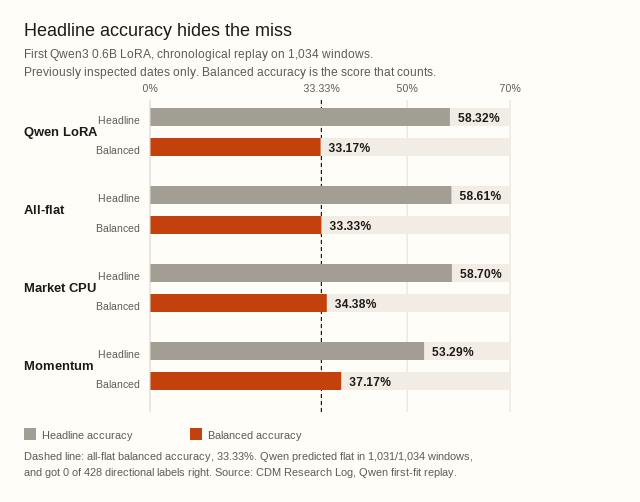
The sealed chronological replay covered 1,034 of 1,034 scheduled windows across 11 previously inspected UTC days. An independent replay matched decisions and labels.
Qwen's headline accuracy was 58.32%. That looks close to the all-flat baseline at 58.61%, and a little ahead of momentum at 53.29%. Balanced accuracy tells the actual story: Qwen 33.17%, all-flat 33.33%, a market CPU baseline 34.38%, and momentum 37.17%. Qwen predicted flat in 1,031 of 1,034 windows and got none of the 428 directional labels right. The headline number mostly reflected class imbalance.
This is a direction-only diagnostic on previously inspected dates, not a fresh held-out validation, and not simulated execution.
Scroll sideways to read it. The labels stay full size.
A class-balanced follow-up did not rescue it. On 372 earlier chronological development windows, balanced accuracy was 29.21% for the balanced LoRA, against 39.28% for momentum and 33.33% for all-flat. It got 28 of 69 up labels and 22 of 79 down labels right, but predicted a direction for 181 of 224 actual flat windows. The development gate failed.
On a sealed September stress test, earlier than all 23 training dates, both the Qwen and GPT-2 adapters predicted flat on all 658 of 658 windows: 33.33% balanced accuracy, against momentum at 36.01%. The hurdle was 35.33%. The branch closed.
Other direction tests didn't overturn that
These are separate studies. I don't pool them.
- On 372 forward Binance windows, a cross-asset model scored 31.72% balanced accuracy, against 33.70% for BTC-only and 42.86% for momentum. Adding other assets did not improve BTC direction calls.
- Across 492 windows, a January–February spot-versus-perpetual taker-flow context lagged the matched BTC-only baseline by 1.04, 1.19 and 0.88 percentage points in three folds, and caught zero up cases.
- On 164 April windows, a Huber magnitude model reached 55.56 bps MAE and 30.99% balanced accuracy, behind a matched classifier at 54.53 / 32.86% and a zero forecast at 54.01 / 33.33%. It caught no up or down labels.
- Doubling the training window from three weeks to six, on 117 four-hour October windows, moved balanced accuracy from 38.61% to 35.84%, with momentum at 39.91%.
- A 2× weighting on verified out-of-fold misses, on 495 fresh November 2024 windows, moved balanced accuracy from 36.19% to 36.93%. Down recall rose from 3.05% to 4.58%, still below the 10% gate.
- Equal-row pooling of BTC, ETH, SOL and XRP raised up recall from 6.45% to 16.13% and down recall from 4.65% to 20.93%, but balanced accuracy was 34.12% pooled versus 34.31% BTC-only.
Momentum itself is only a comparator. On 249 windows across April, July and October 2023, fixed momentum scored 33.61% balanced accuracy against 33.33% for staying flat. The interval included zero. I didn't promote it.
The hedge result is about size, not a trading edge
A BTC/ETH comparison, across 432 aligned historical intervals, measured marked-price risk only, not fills, fees or profit and loss. In the equal-gross comparison, halving BTC size explained 87.5% of the pooled variance reduction and 80.1% of the downside-tail reduction. Compared with the same half-sized BTC position, the small hedge had a pooled standard deviation of 55.03 versus 72.90 bp, and a worst-decile downside of 105.66 versus 140.63 bp. No individual period cleared both of its checks.
After-cost trading is blocked by missing evidence
The after-cost gate is separate from the forecasting work. It requires 200 or more eligible completed simulated round trips, and both the observed win rate and a dependence-aware lower bound strictly above 50%. A 26-week historical screen found zero qualifying execution days. No strategy has demonstrated a strictly above-50% after-cost win rate and positive after-cost performance.
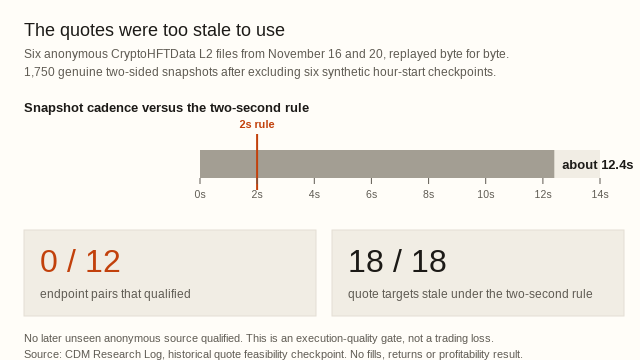
A separate quote-feasibility check explains part of why. I downloaded six anonymous CryptoHFTData L2 files from 16 and 20 November and replayed them byte for byte. After excluding six synthetic hour-start checkpoints, 1,750 genuine two-sided snapshots remained. The snapshot cadence was about 12.4 seconds. All 18 distinct quote targets were stale under a two-second exchange-and-receipt rule, so 0 of 12 endpoint pairs qualified. There is no execution-return or profitability result from this check.
Scroll sideways to read it. The labels stay full size.
Why the work is parked
An aggregate-only review of 41 records in the Kingston ledger reproduced exactly. Incompatible results were not pooled. The 501-decision, 84-date replication still supports pooled probability improvement only. Direction remains unproven, the hedge findings are marked-price risk only, and execution-quality evidence is absent.
Fits and strategy scoring are parked. The exact probability study can resume only with 84 independently verified untouched historical dates and the unchanged preflight. A distinct diagnostic needs genuinely new qualifying evidence. Both CDM December checks, a 2 December quote check and a 15 December held-out check, remain paused. Existing evidence and seals are preserved.
Missing data is a blocker, not a loss, and not a training label.
What this is, and isn't
CDM is historical research. It is not live signals, not a trading product and not investment advice. The repo is private. The numbers in this post come from the research log as of 24 November 2026, 9:08 pm Pacific/Auckland.
I'm interested in applied AI and evaluation work. CDM is my example of keeping the questions separate: a probability pass, a direction miss, an execution gate that never opened, and a stop when the evidence ran out.
Related posts
Continue with articles that overlap in category or shared tags.
ai
I built Cuqe so a small local model can say no to an agent's action
A 0.6B verifier that runs on a Mac, scores whether a proposed action matches the request, and declines anything under a calibrated cutoff. In archived development runs it kept 39 of 48 correct actions, declined 44 of 48 when the right action was missing, and answered at 365 ms p95.
Read related postai
I built agent-guard to decide whether an agent's change should go live
A check-apply-verify harness for agent edits. It probes the live system first, applies the change, probes again, and rolls back with a fresh recovery probe when the change breaks something. 24 of 24 replayed scenarios land on the exit code they should.
Read related postai
I built cue-bench to score browser agents on messy retail work
A local Playwright workbench, matched replays, and a ledger grader. 172 receiving attempts, zero recovery passes, and one run that posted 13 ink jackets and zero moss jackets.
Read related post