ai
A small trading book, a written rulebook, and an agent inside both
An experimental Hyperliquid desk with a written rulebook, a hard equity stop, and autonomy inside those limits. No return figure.
- #ai-agents
- #trading
- #hyperliquid
- #operations
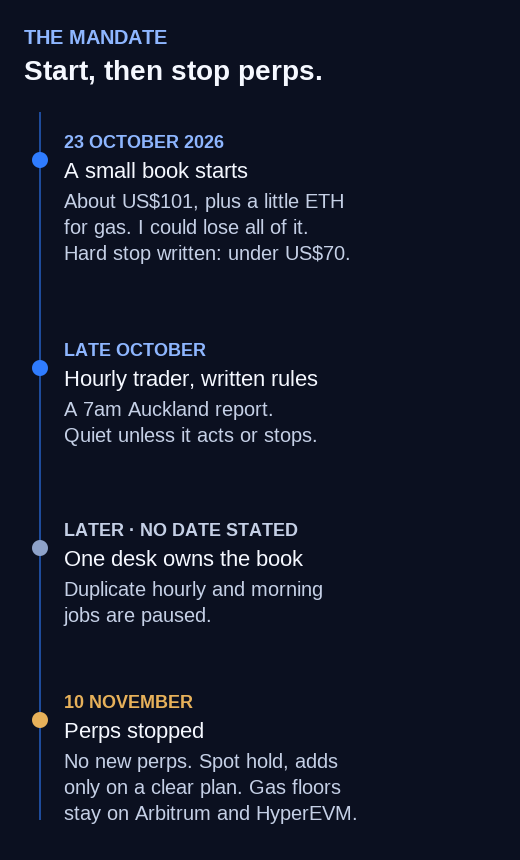
In late October I gave an AI agent a small experimental wallet on Hyperliquid and a written rulebook. The point was not to get rich. It was to find out whether an agent can trade inside hard limits, report clearly, and stop when the rules say stop.
The starting book was modest, on purpose: about US$101 plus a little ETH for gas, on 23 October 2026. I accepted that I could lose all of it. I did not want a bot that pinged me about every order. I wanted a quiet hourly trader, a 7am Auckland morning report, and a hard stop if equity fell under US$70.
An X markets bot feeds market chatter in as briefs. That bot does not trade. The trading desk may treat those briefs as leads, not as facts, and it has to check them on-chain before it acts. If this setup sounds more like operations than a strategy video, that is the idea.
This is the same habit as the client desk, in a different domain: written rules, scheduled jobs, and one owner for the live system. It is play money I was willing to lose. It is not investment advice.
Why this experiment exists
The question is a production-ops question, not a performance claim. Can an agent hold a mandate overnight, log every action, and obey a stop? I will not present the book as something to copy with money you cannot lose.
The desk, not a trading bot
Crypto Desk, later titled HL Experiment Desk, owns the experiment wallet end to end. I later paused a second copy of the same jobs on the routing bot so two agents could not trade the same book.
The work lives in a small ops folder: status checks, a trade log, a price watcher, and a RULES.md file the agent is supposed to follow. A dashboard page is meant to show equity, holdings, the trade log, and the rules, and to be updated with the morning report. That page stays internal.
The two routines
The hourly trader runs around the clock, because the market does not sit in Auckland hours. It is supposed to stay quiet unless it takes an action or hits a stop. Early on I asked for checks every hour, not once a day. I then told it to be less conservative: take reasonable setups and keep the risk small, rather than waiting for a perfect breakout.
The morning report is about 7:00am NZDT. The brief I asked for was equity versus the start, how the book is split, open positions, overnight change, any rule breaches, the trades with links, and one next action. No play-by-play during the night.
A price watcher is meant to run continuously and restart itself within a few seconds if it dies.
Once perps stopped, an hourly job that was still hunting entries would have been the wrong product. The job had to follow the new mandate instead: no new perp entries, a spot hold, and adds only on a clear plan.
Scroll sideways to read it. The labels stay full size.

A model checker verified the written rules hold, including leverage never above 3x and the stop under US$70.
Sizing and risk, as written
Stick to the rulebook. These are design choices, not results, and they do not make the book safe.
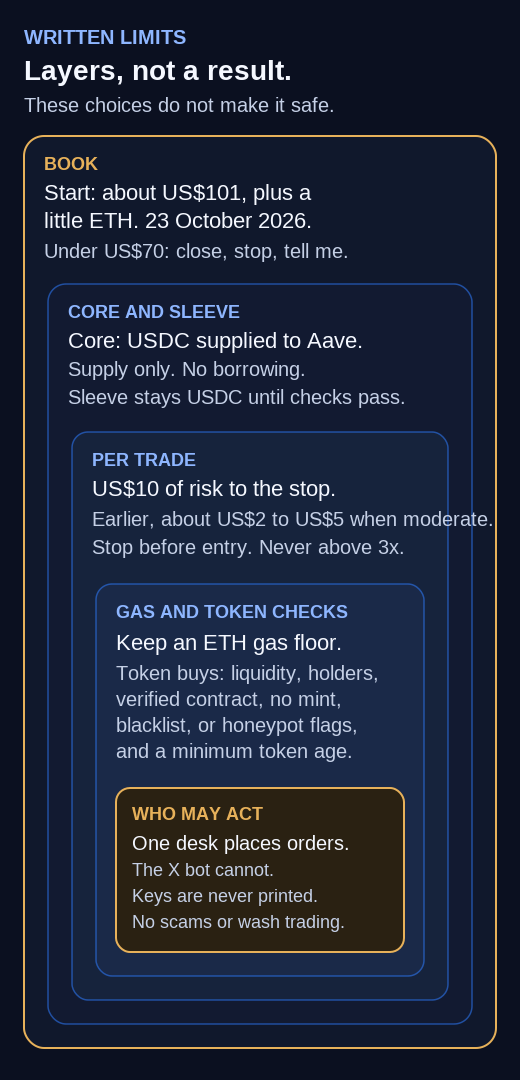
The written split was a lower-risk core and a smaller opportunity sleeve. The core was USDC supplied to Aave, supply only, with no borrowing. The sleeve stayed in USDC until a trade passed the checks.
The written per-trade cap was US$10 of risk to the stop. Earlier, I had also said to size about US$2–5 when conviction was only moderate.
Every trade needed a stop defined before entry, placed on the exchange or monitored at a fixed level. Leverage was never above 3x. A gas floor in ETH was there so the agent could not strand itself.
Token buys had to pass basic safety checks: liquidity, holder distribution, a verified contract, no mint, blacklist, or honeypot flags, and a minimum token age.
The hard stop was blunt. If total equity fell under US$70, close positions, stop trading, and tell me.
No scams, exploits, manipulation, or wash trading. Every on-chain action logged. Private keys never printed or shared.
Autonomy inside hard limits
I did not approve every trade. Human control was not a tap on each order. It was autonomy inside hard limits, on a wallet I could afford to lose.
I wrote the mandate, including the US$70 stop, the leverage cap, and the logging rule. I changed the risk posture when I wanted it less conservative. I could pause jobs, move ownership to a single desk so nothing double-traded, and later stop the perp experiment altogether. Alerts were reserved for the morning report and for a breach of the stop, not for a running commentary.
The X markets bot can talk. It cannot place orders. The desk keeps sole control of trades.
The 10 November mandate change
On 10 November I stopped the perp experiment. The documented update says: do not open perps, and move the sleeve to a Hyperliquid Core spot hold, with adds only on a clear plan. Gas floors stayed in place, on both Arbitrum and HyperEVM.
That change is the useful part of the story. An agent that can trade also has to accept a human changing the product, mid-flight, from hourly entries with a stop to a hold that is not supposed to get clever. The rule file had to change with the decision. Otherwise the hourly job would keep doing yesterday's product.
Chatter is not a trade
The X markets bot is a companion, not a second trader. It feeds chatter. Crypto Desk has asked it for short scans on names already in view, and has said out loud that it will treat the result as leads, not facts, and check them on-chain before suggesting anything.
A brief can be useful and still be wrong. Fake tokens and noisy chatter are part of the point, which is why that bot must not have trade permissions.
What the operating record supports
Two agents must not own the same live trading job. I consolidated the hourly and morning jobs onto one desk and paused the duplicates.
Quiet operations need a watcher that restarts, a log, and a report you actually read. Autonomy without those is just an unattended session.
A hard equity stop is a product feature, not a feeling. I said I would accept losses as long as the risk rules held, and that the agent should learn from stop-outs. Market chatter stays an input with a different permission set from trading. That split is the same idea as drafting a client email and not sending it.
What I will say about the book
I started a small, loseable book on 23 October 2026, wrote the limits down, and let an agent operate inside them. I later stopped the perp sleeve and changed the mandate. I am not publishing a return figure in this post.
This is an experiment in giving an agent a narrow live authority, not a strategy I would run with money I cannot lose. The portable part, for work I want to be hired to do, is the same as the client desk: written limits, one owner, scheduled reporting, and a clean separation between research and actions that spend.
I build open-ag for that kind of agent work. This experiment is not a claim that the book runs on it.
Related posts
Continue with articles that overlap in category or shared tags.
ai
Running a one-person agency with AI agents: what actually broke
What it looks like to run a one-person agency desk of AI agents near live ads and a live website, including the parts that failed.
Read related postengineering
Paper Trading Bot: Research Stack for Hyperliquid Perps
A case study in separating research, simulation, analytics, dashboarding, and live-risk controls in a Hyperliquid trading system.
Read related postai
I built Cuqe so a small local model can say no to an agent's action
A 0.6B verifier that runs on a Mac, scores whether a proposed action matches the request, and declines anything under a calibrated cutoff. In archived development runs it kept 39 of 48 correct actions, declined 44 of 48 when the right action was missing, and answered at 365 ms p95.
Read related post