ai
Running a one-person agency with AI agents: what actually broke
What it looks like to run a one-person agency desk of AI agents near live ads and a live website, including the parts that failed.
- #ai-agents
- #operations
- #wordpress
- #agency
I am a full-stack engineer who runs Tien Phong Limited, a small digital agency.
I run a one-person digital marketing agency. There is one client: a Wellington renovation company. For the last few months I have been running that work with a small team of AI agents. This is what that looks like in practice, including the parts that failed.
Most AI-at-work posts stop at the demo. The useful question is whether you can put agents near live systems without letting them invent numbers, send a client email, or take a site down.
I also build open-ag. The client desk in this post is separate from that project.
The desk
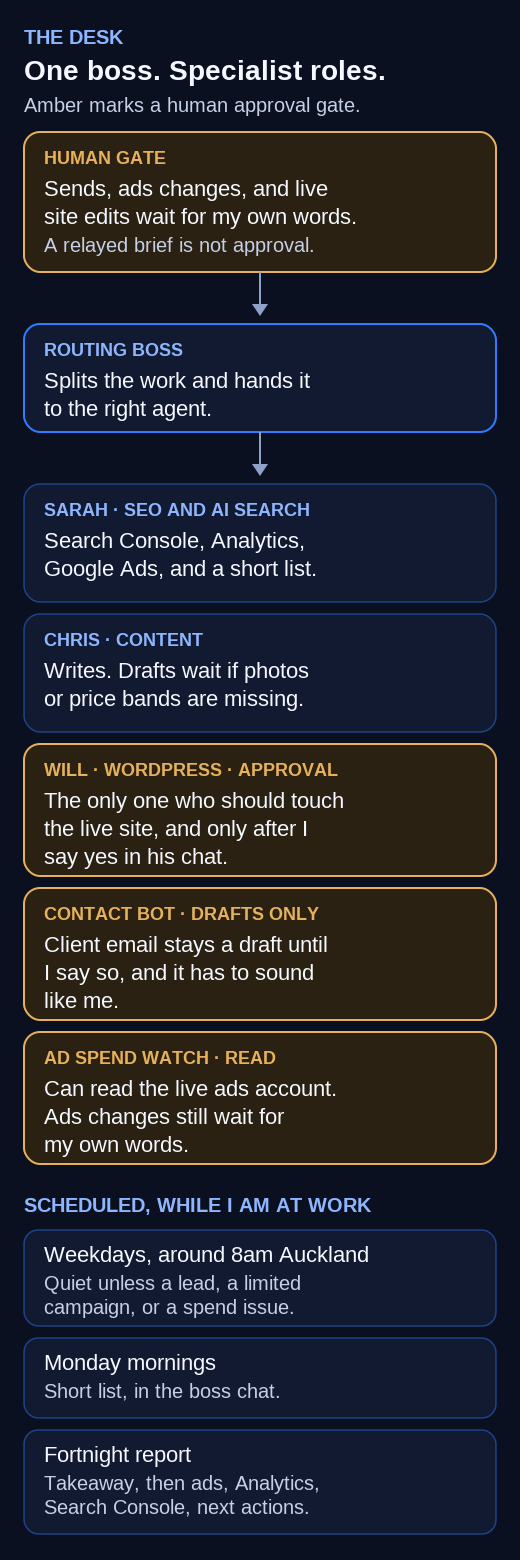
I do not have one general-purpose chatbot doing the lot. I have a desk of specialists, with a routing bot I treat as the boss.
The boss is the hub. It splits the work and hands it to the right agent. Sarah runs the SEO and AI-search desk: Search Console, Analytics, Google Ads, and a short list of what is actually moving. Chris writes. Will is the WordPress IT agent — the only one who should touch the live site, and only after I say so in his own chat. A contact bot drafts client email and waits. Ad Spend Watch can read the live ads account.
On top of that there are scheduled jobs, so the work still happens when I am in my day job:
- A weekday ads lead watch around 8am Auckland time. It stays quiet unless there is a lead, a campaign stuck in a limited state, or a spend issue I need to see.
- A weekly marketing short list, Monday mornings, in the boss chat.
- A fortnight performance report in a fixed format: the main takeaway first, then ads, Analytics, Search Console, and the next actions.
That structure matters more than the model names. Each agent has a job, a set of tools, and a list of things it is not allowed to do.
The guardrails
The rules are not a vibe. They are the operating system.
Sends, ads changes, and live site edits wait for my own words. A brief relayed through another bot is not approval. For a long time, Will would prepare backups, diffs and rollback scripts, then wait until I said yes in his chat. Email to the client is drafts only. Nothing goes out unless I say so, and even then the draft has to sound like me.

A model checker verified these gates. Nothing goes live, and nothing gets sent, without my yes.
Agents are not allowed to invent numbers, prices, photos or reviews. If a proof point is missing, the page stays without it. If a photo is stock, it does not get alt text that pretends it is a real local job. I would rather ship a thinner page than a confident fiction.
Before a live change, there is a backup. After it, there is a way back. Rollback files live next to the fix. When we repaired the quote forms in mid-November, the undo script was already on the server.
There are quieter rules too. Ads spend figures do not go to the client. Campaigns stay paused until I say otherwise. Preview servers get closed when the work is done.

Five things that broke, and what I changed
1. The quote forms stopped emailing
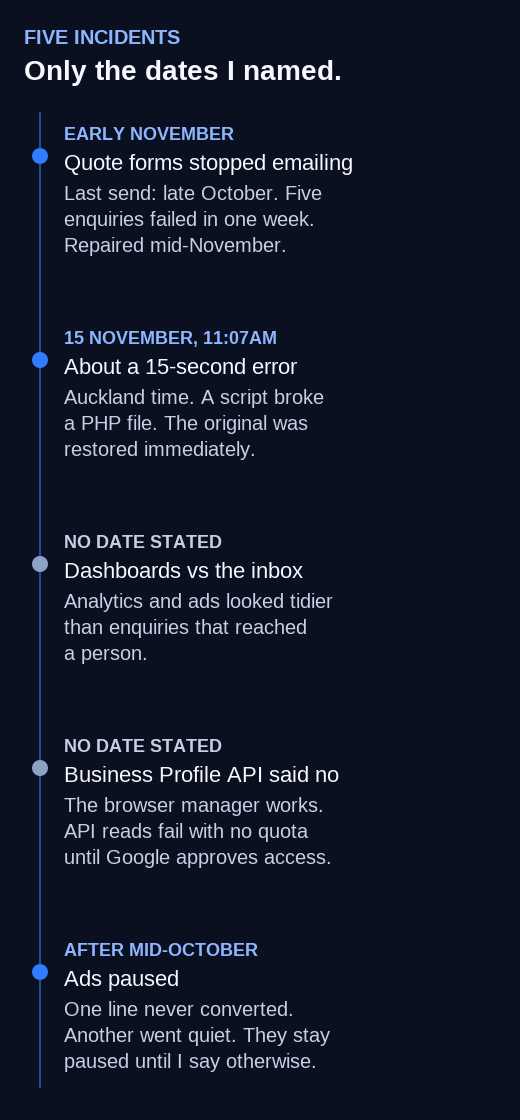
In early November, the website quote forms stopped sending mail. Visitors still submitted them, and the submissions were saved in the site's form log, but they never reached the business inboxes.
By the time we caught it, five enquiries from a one-week window had failed. A couple of those looked like real kitchen jobs. The last successful send had been in late October. The cause was not a downed mail server. It was a corrupted mail setting: a dash in the email subject had been stored in a way the form plugin could not safely use.
I told Will to fix the forms. He re-saved the mail settings with a plain hyphen, changed nothing else, and ran one enquiry clearly marked TEST. It arrived. He also added a small server add-on that emails me if a form fails again, at most once every ten minutes, and left a one-command rollback beside the fix.
The lesson is simple. An agent that can edit a live WordPress site also needs a way to notice that a side effect failed. A form can "succeed" in the database and still never send. The test enquiry and the failure alert are now part of the system, not a one-off cleanup.
2. A 15-second site error
On 15 November, during a batch of approved site updates, the whole site showed an error page for about 15 seconds, from 11:07am Auckland time. A script that was adding a short positioning line to existing pages broke a PHP file. Will restored the original file immediately, fixed the line, and changed the script so it runs a PHP syntax check before saving a file like that. The site has been fine since.
That is the incident I would bring to an interview. The failure mode is how agent-assisted production work goes wrong: a narrow, approved edit, applied by a script, in a file the language will not even parse. The fix was not "be more careful." It was to put a mechanical check in front of the write. That check should have existed before the deploy, not after it.
3. Conversion tracking was telling a tidier story than the inbox
For a while the dashboards were easier to read than the truth. Analytics would show lead-like events. Ads would show primary conversions. The client's actual enquiries did not line up with either.
A few hygiene problems showed up. A form-start event was firing, but a proper form-submit event was not being tracked. There was a risk of counting the same enquiry twice through two slightly different lead events. At one point the ads conversion tag was not even on the site. Phone clicks were a useful signal, and I kept them as a key event, but a phone click is not a booked job.
The habit I kept was this: treat platform events as clues, not as customers. Before anyone talked about restarting ads, we had to know whether a "lead" had reached a person.
4. The Google Business Profile API said no
I can manage the client's Google Business Profile in the browser. Getting an agent to read it through the official API was a different project. I added the agency account as a manager, stood up the connection through a cloud project, and submitted the access request Google requires.
The connection looks fine. The reads still fail, because the project has no quota until Google approves that request. "The integration is built" and "it works in production" are not the same state. I would rather leave that gap visible than pretend a profile manager in the browser is the same as a reliable API.
5. I paused the ads that were not converting
The agents can watch campaigns every morning. They can recommend negatives, clean up claims we could not verify, and flag a campaign that is stuck. They do not get to keep spending because the routine is still on.
When the ads stopped producing real conversions, I paused them. One service line had never converted. Another went quiet after mid-October. Pausing also stops the learning, but running more of the same would have been theatre. The campaigns stay paused until I say otherwise.
That is the other half of autonomy. An agent that can change bids also has to be allowed to recommend doing nothing, and I have to be willing to take that recommendation.
What this looks like when it is going well
The interesting days are not the deploys. They are the quiet ones.
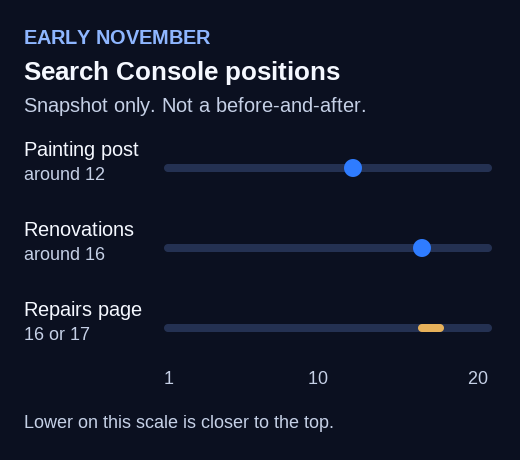
Sarah's Monday list is short on purpose. A repairs page sitting around position 16 or 17 in Search Console, an interior painting post around 12, a broader renovations query around 16: those are snapshots from early November, not a before-and-after story. One location page was already pulling a lot of impressions from a strong average position and still getting almost no clicks. That is a content and proof problem, not a "write more pages" problem.
Chris's job, in that context, is to write things we can stand behind. If the real job photos or price bands are missing, those drafts wait. Will's job is to put the approved words on the site with a backup and a way home, and to refuse the rest.
I still do the parts that need a person: talking to the client, deciding whether ads restart, and judging whether a sentence over-claims.
What I would tell a hiring manager
I am not claiming this is a product. It is a working desk on a real client, with real failure modes.
The parts I would hire for are not the routing diagram. They are the boring ones: approval gates, drafts instead of sends, no invented proof, rollback files, a syntax check before a PHP write, a form-failure alert, and the willingness to pause spend when the inbox and the dashboard disagree.
If I built this again, I would put the verification harness in first. The 15-second outage was short because the rollback was fast. It would have been shorter if the script had refused to save an unparsable file. I would also instrument the enquiry path on day one, so a form can fail loudly instead of going quiet for a week.
The agents do a lot of the research, the drafting, the watching, and the careful edits. I still own the outcome.
I am interested in applied AI and agent-engineering roles. That is the work I want next: agents close to live systems, with the limits written down, and a person who still owns the outcome.
Related posts
Continue with articles that overlap in category or shared tags.
ai
A small trading book, a written rulebook, and an agent inside both
An experimental Hyperliquid desk with a written rulebook, a hard equity stop, and autonomy inside those limits. No return figure.
Read related postai
I built Cuqe so a small local model can say no to an agent's action
A 0.6B verifier that runs on a Mac, scores whether a proposed action matches the request, and declines anything under a calibrated cutoff. In archived development runs it kept 39 of 48 correct actions, declined 44 of 48 when the right action was missing, and answered at 365 ms p95.
Read related postai
I built agent-guard to decide whether an agent's change should go live
A check-apply-verify harness for agent edits. It probes the live system first, applies the change, probes again, and rolls back with a fresh recovery probe when the change breaks something. 24 of 24 replayed scenarios land on the exit code they should.
Read related post