ai
Codex Symphony: Closing the Loop Between AI Work and Human Review
A local control loop for turning Linear issues into scoped Codex work, reviewable artifacts, and the next ticket when a user finds a real problem.
- #ai-agents
- #codex
- #linear
- #workflow
- #human-review
Problem
A coding agent session can be productive and still be a poor operating model for real work.
A Linear issue needs to become a bounded piece of work. The work needs a repository and a workspace that are safe to touch. The person who asked for the change needs a way to review the outcome. And when that review finds something wrong, the discovery needs to become the next well-scoped issue—not a loose message that disappears into the previous session.
I built Codex Symphony to make that loop explicit.
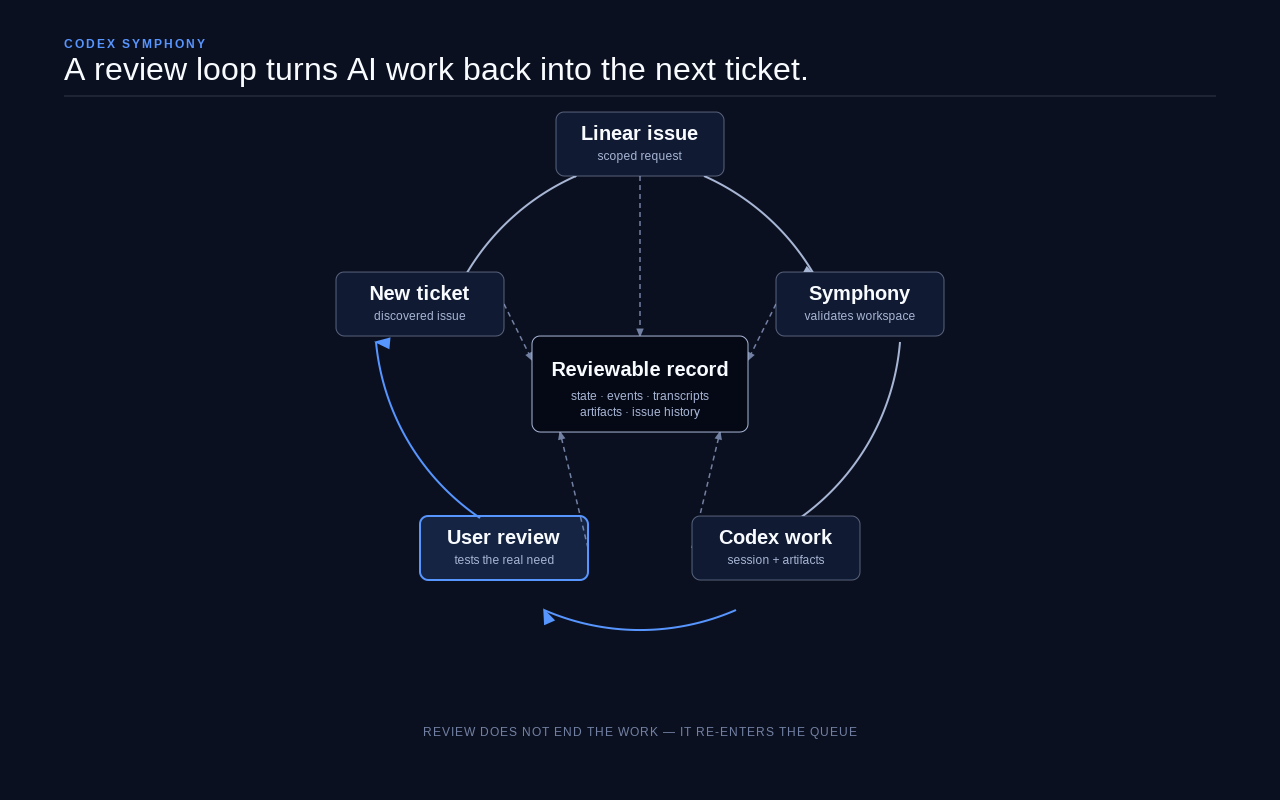
At the time, Codex Remote was not part of my workflow. I wanted a local control surface that could turn a Linear issue into an isolated Codex session, preserve the useful operational record around it, and bring the result back to a human review point.
Constraints
The useful version was not “launch as many agents as possible.” It needed a few strong boundaries:
- Linear remains the work queue. The issue defines the requested outcome and the next item of work.
- The workspace must be deliberate. A session should not casually operate inside whichever checkout happens to be open.
- The agent needs an observable trail. State, events, transcripts, and artifacts need a durable boundary so the operator can understand what happened.
- Human review is a real stage. A passing session does not replace the person validating the result against the actual need.
- Review findings restart the loop. A newly discovered problem is a new ticket, not an invisible amendment to the previous task.
Those constraints are familiar from integration engineering. The reliable part is not the handoff itself; it is knowing which system owns each state, what gets recorded, and how a failure becomes actionable work.
Build
Symphony is a TypeScript/Bun orchestration project with a browser operator surface, API layer, local daemon, shared contracts, runtime workflow logic, and optional trusted-server persistence. Its purpose is narrower than a general “AI company in a box”: coordinate bounded Codex work from a real issue queue.
The operating loop is intentionally linear:
- Linear supplies a scoped issue.
- Symphony validates the workflow and workspace rules, then starts a Codex session in the intended workspace.
- Work produces an observable trail: runtime state, events, transcripts, and artifact records.
- User review checks the result against the real requirement, not only the agent’s summary.
- A discovered issue becomes a new Linear ticket.
- The next ticket starts the loop again.
That last transition is the point. Review is not a ceremonial final step. It is how new information re-enters the work system in a form that can be prioritised, scoped, and verified.
The implementation reflected those boundaries:
- a local daemon owns issue polling, session hosting, and operational journals;
- shared contracts keep the dashboard and API aligned on runtime, event, transcript, artifact, and tracker-write shapes;
- runtime logic owns workflow parsing, prompt rendering, workspace validation, and the Codex bridge; and
- privileged hooks, secrets, and workspace execution remain outside the browser surface.
This is the same preference for explicit handoffs behind Codex Cross-Session: AI work becomes more useful when its context and operating boundaries are visible rather than hidden inside one chat.
Result
The result was a control-plane-shaped workflow for Codex work rather than a dashboard mockup: Linear-oriented intake, local orchestration, observable session records, and a human-owned feedback loop.
The latest local project evidence I have is an April 2026 repository ingest. It described Symphony as suitable for a controlled pilot, while keeping some hardening work visible: workflow-bootstrap validation, broader smoke coverage, lint/import-boundary checks, and browser end-to-end coverage were not yet complete. That is the honest status—not a claim of unattended or production-scale autonomy.
Codex now offers Remote workflows for starting, guiding, approving, and reviewing work from another device. That is a useful platform capability, but it does not remove the design question Symphony was built to explore: how does a team turn review feedback into the next traceable unit of work?
Lesson
The interesting part of AI-assisted engineering is not just getting a model to edit a repository. It is designing the loop around the edit.
Linear gives work a place to begin. An isolated workspace gives it a safe place to happen. Observable artifacts make it reviewable. Human review tests it against the real need. And a new ticket gives discovered work a place to go.
That loop turns AI activity into an engineering process rather than a collection of impressive but disconnected sessions.
Source notes
This article describes my Codex Symphony workflow and uses the latest local repository evidence available to me, dated April 2026. It does not claim ownership of Codex, a verified Codex Remote launch timeline, autonomous production operation, or measured delivery outcomes. Current Codex Remote capabilities are described in the official Codex Remote documentation.
Related posts
Continue with articles that overlap in category or shared tags.
ai
I built Cuqe so a small local model can say no to an agent's action
A 0.6B verifier that runs on a Mac, scores whether a proposed action matches the request, and declines anything under a calibrated cutoff. In archived development runs it kept 39 of 48 correct actions, declined 44 of 48 when the right action was missing, and answered at 365 ms p95.
Read related postai
I built agent-guard to decide whether an agent's change should go live
A check-apply-verify harness for agent edits. It probes the live system first, applies the change, probes again, and rolls back with a fresh recovery probe when the change breaks something. 24 of 24 replayed scenarios land on the exit code they should.
Read related postai
I built cue-bench to score browser agents on messy retail work
A local Playwright workbench, matched replays, and a ledger grader. 172 receiving attempts, zero recovery passes, and one run that posted 13 ink jackets and zero moss jackets.
Read related post