engineering
Enterprise Integration Work Across Retail Operations
A public-safe look at the source-of-truth and workflow boundaries behind enterprise retail systems.
- #integration
- #aws
- #typescript
- #systems
The shape of the work
In my current integration work, I sit in the space between business operations and production systems. The job is not just connecting APIs. It is deciding which system owns which fact, how changes move, where operators review work, and how failures become visible before they turn into manual cleanup.
The stack spans ERP, ecommerce, warehouse, and internal workflow surfaces. In practice that means Accredo, Shopify, Magento, warehouse processes, AWS services, DynamoDB-backed workflow state, and internal tooling all need to behave like one operating system for the business.
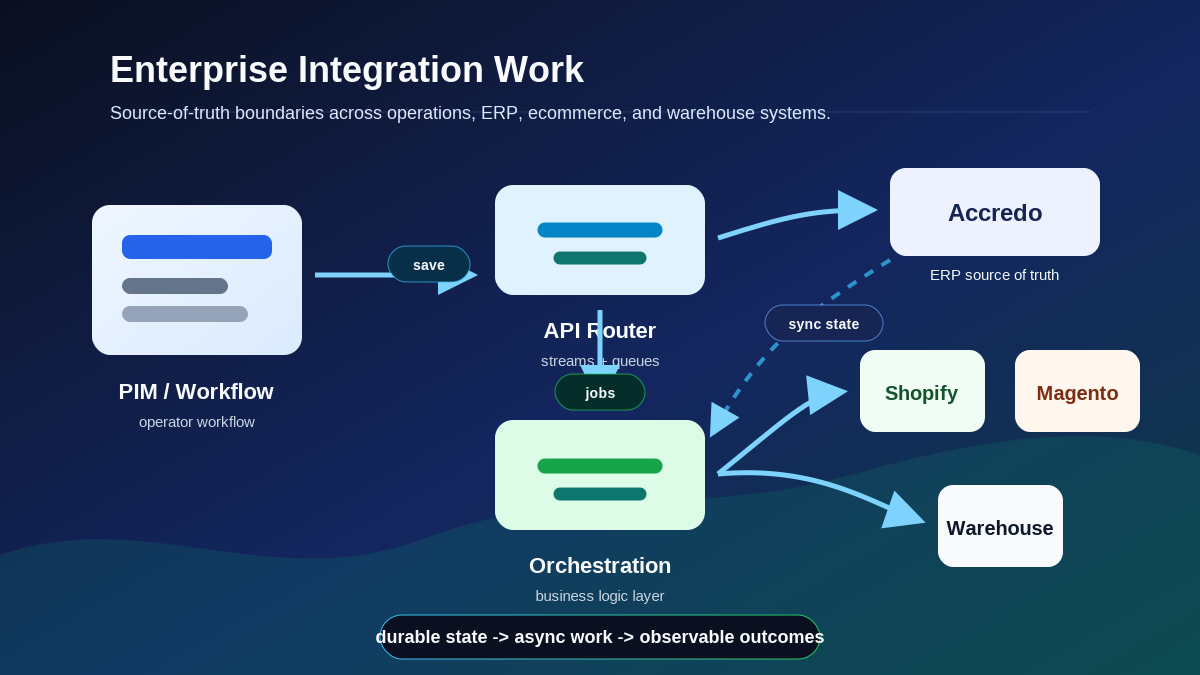
Source of truth before code
The highest-leverage part of integration work is usually not the transport layer. It is the ownership boundary.
For product data, the useful model is that the PIM workflow owns the working product record before downstream sync pushes changes into Shopify, Magento, and related systems. For purchasing and stock-related workflows, Accredo remains the canonical system while internal tooling acts as the operational surface for review, edits, receipting, and sync staging. Other financial or transaction-led workflows follow a similar pattern: keep a clear operational ledger before outbound sync.
That distinction keeps the architecture from becoming a set of accidental point-to-point scripts. A connector can be replaced. A confused source of truth becomes a recurring production problem.
Layered delivery
The work is split across a few layers:
- an operations control layer where people review, approve, amend, and audit work
- a contract/API layer for authentication, schema validation, idempotency, and routing
- an execution layer for durable state, retry-safe orchestration, and downstream synchronization
In AWS terms, that means API Gateway and Lambda for ingress, EventBridge, Step Functions, and SQS for orchestration, and DynamoDB for durable workflow state.
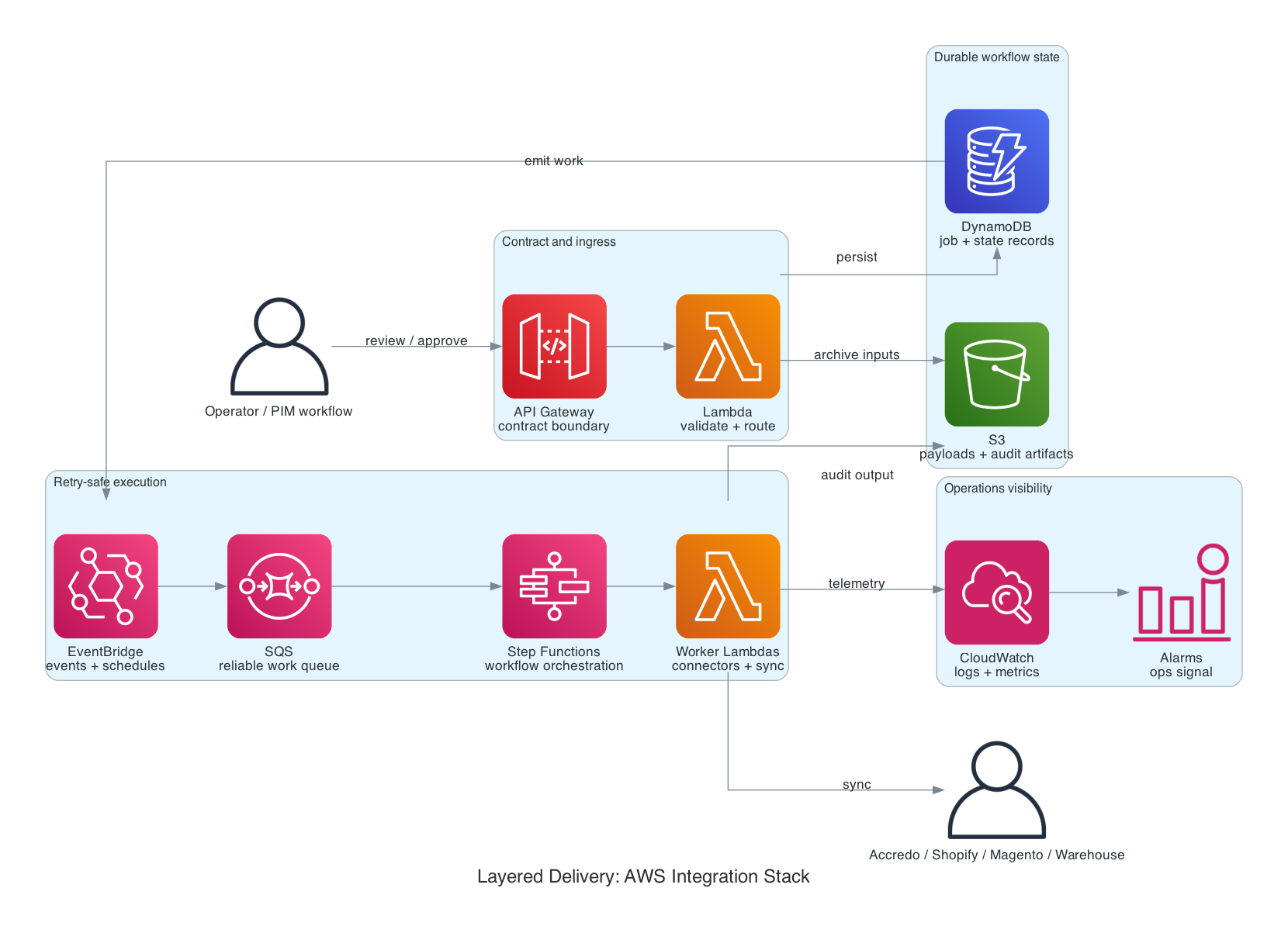
That split only works when contracts stay explicit. A user-facing change may need a backend shape, a DynamoDB persistence contract, and a worker behavior to move together. The engineering challenge is less about writing code in one place and more about preserving the behavior across the whole chain.
The recurring pattern
Most reliable workflows follow the same backbone:
- An operator creates or reviews a change in the workflow system.
- The API layer validates the change and persists a durable job/state record in DynamoDB.
- A workflow event is published through EventBridge or SQS.
- Step Functions coordinates Lambda workers to execute outbound syncs.
- Scheduled or event-driven reconciliation compares source-of-truth and downstream state.
- CloudWatch metrics/logs, retry metadata, and immutable artifacts in S3 make failures inspectable.
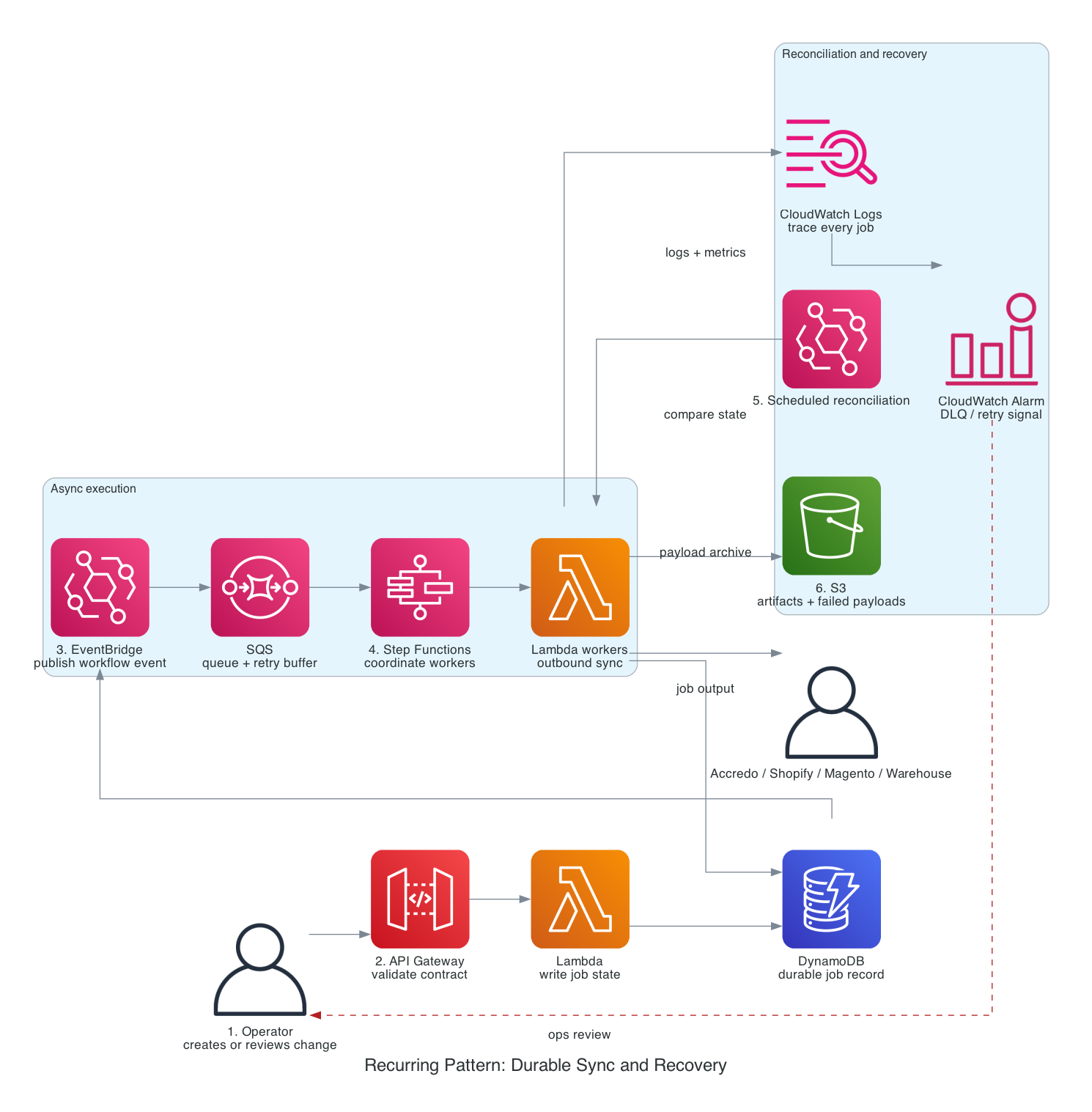
That pattern shows up across product, media, purchasing, and other operational flows. The domain details change, but the engineering pressure is consistent: durable state first, async work second, observable outcomes always.
What this work taught me
Enterprise integration punishes vague contracts. If two systems both think they own the same field, the bug may not appear as a crash. It appears as a stock mismatch, a stale product, a duplicated job, or an operator spending an afternoon fixing data by hand.
The best fixes are often boring: clarify the owner, make the job state durable, fail closed when assumptions are wrong, and prove behavior against the real backend instead of only the UI. That is the part of integration engineering I enjoy most: turning messy operational reality into systems that people can trust.
Related posts
Continue with articles that overlap in category or shared tags.
ai
AI Is Not the System of Record
A practical framework for using AI in workflow-heavy systems without confusing a helpful model with the source of truth.
Read related postengineering
Meili UI: A Local-First Admin Surface for Meilisearch
A case study in turning repeated search-index maintenance into a focused internal operator tool without overbuilding the deployment boundary.
Read related postai
I built agent-guard to decide whether an agent's change should go live
A check-apply-verify harness for agent edits. It probes the live system first, applies the change, probes again, and rolls back with a fresh recovery probe when the change breaks something. 24 of 24 replayed scenarios land on the exit code they should.
Read related post